
SONOMA COUNTY, Calif. — October 29, 2026. A half-century partnership at one of California’s most distinctive historic sites is facing a major change. Fort Ross Conservancy says the Sonoma-Mendocino Coast District of California State Parks has decided not to renew its cooperating association agreement with the nonprofit. The agreement, identified in a public petition as P21CO017, is scheduled to expire on November 3, 2026.
The dispute concerns how educational programs, fundraising, volunteer support and interpretation are organized at Fort Ross State Historic Park. It is not an announcement that the state-owned park is closing, that its land is being sold or that California is surrendering control of the site. The Conservancy says it will continue as an independent nonprofit, although the practical consequences for its work inside the park remain to be clarified.
Where is Fort Ross, and how large is the park?
Fort Ross stands on the Sonoma Coast along Highway 1, approximately 12 miles north of Jenner, at 19005 Coast Highway One, Jenner, CA 95450. The state historic park encompasses roughly 3,400 acres of coastal bluffs, coves, forest, historic structures, archaeological resources and trails. It is much more than the wooden fort compound familiar from photographs. The protected landscape includes natural habitats, the former Russian settlement, and features associated with later California ranching.
The park is part of the California Department of Parks and Recreation system, not property owned by the Conservancy. California State Parks manages public access and protection of the historic resource.
Metini: the Kashia Pomo homeland
The story of this coast did not begin with Russian colonization. The site lies within the ancestral homeland of the Kashia Band of Pomo Indians; the Indigenous village site is known as Metini. Kashia people lived along this coast for generations, gathering marine resources and maintaining extensive cultural and trade connections. The park’s own interpretive materials recognize the Kashia people’s continuing relationship with the land. Any account of Fort Ross that discusses only its Russian years leaves out a fundamental part of the site’s history.
Why did the Russian-American Company establish a settlement here?
In 1812, the Russian-American Company established the settlement of Ross on this coast. The company sought agricultural production and supplies for its North Pacific operations, particularly its settlements in Alaska. Ivan Kuskov is closely associated with the settlement’s founding. The community brought together Russians, Native Alaskans, Kashia and other Native Californians, and people of mixed ancestry. The settlement was part of a colonial commercial enterprise, and the histories of its different residents cannot be reduced to a single national narrative.
The Russian-American Company withdrew from Ross in 1841. California State Parks describes the site’s later ranching era as another major chapter in the landscape’s history. The state acquired the original fort property in 1906, and the protected area expanded over time.
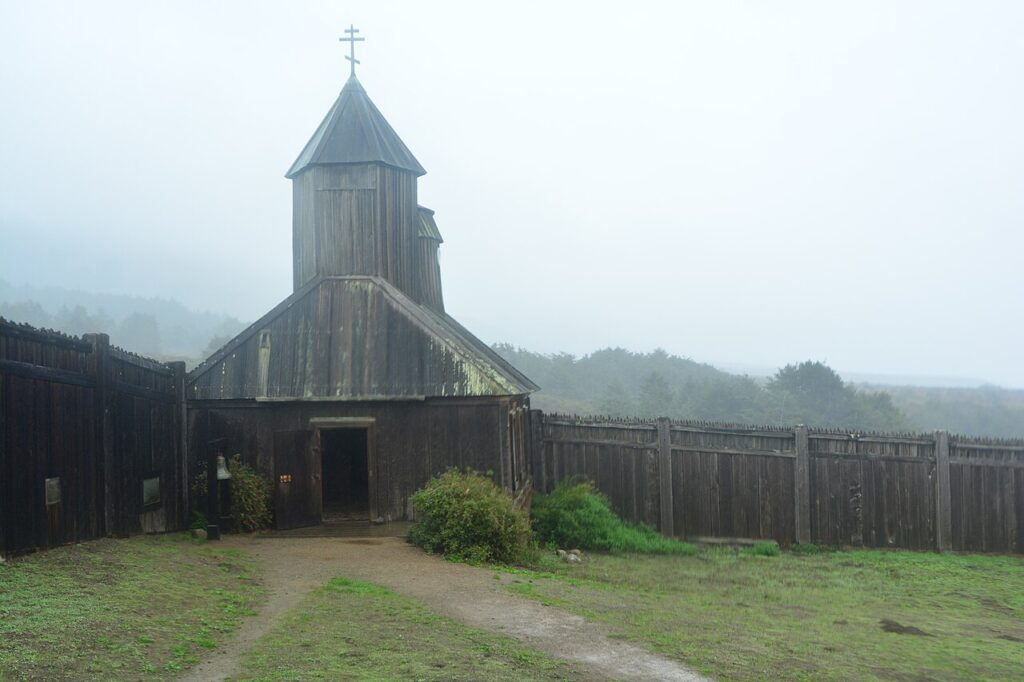
Featured photograph: Fort Ross Orthodox Chapel, photographed by Joe Mabel, October 26, 2021. Licensed under Creative Commons CC BY-SA 4.0; image used without editorial alteration. Photograph depicts the historic site, not the October 2026 agreement decision.

What can visitors see today?
The historic compound includes a reconstructed wooden stockade, blockhouses and a chapel. The Rotchev House, associated with the last Russian administrator, is a rare surviving structure from the Russian period. The chapel was reconstructed after a destructive fire in 1970. Exhibits also explore Native Californian and Native Alaskan experiences, the Russian-American Company, and subsequent ranching families. The park’s natural setting overlooking the Pacific Ocean is an important part of its identity.
What has Fort Ross Conservancy done?
Fort Ross Conservancy, previously known as the Fort Ross Interpretive Association, dates its partnership with California State Parks to 1976. The nonprofit and its supporters have helped with visitor services, a museum bookshop, educational materials, cultural events, volunteer coordination, fundraising, preservation work, historical research and public outreach. Its supporters point in particular to the Environmental Living Program and Marine Ecology Program, which have introduced schoolchildren to local history and ecology through hands-on experiences.
The organization has also maintained historical collections and supported interpretation of the Kashia Pomo, Russian, Native Alaskan and ranching histories associated with the site. These descriptions of the Conservancy’s contributions are drawn from its own statement and the petition; they should not be mistaken for an independent audit of finances or program outcomes.
Education-program clarification: The Conservancy’s Environmental Living Program page separately says that ELP is not operating during the school year described on that page, citing historic-compound building safety concerns and a curriculum review. That posted suspension should not automatically be attributed to the November 3 agreement expiration; the program page does not establish that every other school activity has stopped.
What exactly is ending on November 3?
The issue is a Cooperating Association Agreement, a framework through which a nonprofit supports a public park. In an October statement, Fort Ross Conservancy said California State Parks had chosen not to renew the agreement and called the decision deeply disappointing. A petition names the contract as P21CO017 and gives November 3, 2026 as its expiration date.
California58 has not independently established the full reasons behind the nonrenewal decision from a detailed agency determination. It would therefore be inaccurate to attribute the outcome to a specific financial violation, political dispute or disagreement about Russian history without evidence. Nor does the announcement alone establish that every educational program will be canceled or that the park will close. The next questions are which activities the state will operate directly, which might continue through other arrangements, and whether the two parties will negotiate a transition or extension.
What does the public petition request?
A petition titled “Renew Fort Ross Conservancy’s Agreement and Protect 50 Years of Partnership” was created on October 23, 2026. Its organizers ask California State Parks to reconsider the decision, renew the agreement or arrange a mutually agreed interim extension, establish a written plan for addressing substantiated concerns, and include volunteers, educators, cultural communities and supporters in discussions. Petition signature counts change continuously and should be checked on the petition page rather than treated as a fixed figure.
Read the Change.org petition and its requests. The petition represents its organizers’ position, not an official decision by California State Parks.
How have community organizations responded?
On October 26, 2026, the Congress of Russian Americans published a statement supporting Fort Ross Conservancy and calling for renewed cooperation. The organization cited the site’s historical significance and the nonprofit’s preservation, education and cultural programs. Other stakeholders, including the Kashia community, park employees, educators and residents of coastal Sonoma County, may have distinct perspectives that should not be presumed from that statement alone.
What happens to the park after the agreement expires?
The park remains a California state historic park. The agreement’s expiration does not by itself revoke its designation or shut its gates. Fort Ross Conservancy says it intends to continue its work as an independent organization. What is not yet established is the final arrangement for staffing visitor services, running educational programs, coordinating volunteers, handling collections or conducting events after November 3. California58 will update this article if California State Parks or the Conservancy publishes a definitive transition plan or new agreement.
How to visit Fort Ross
The official state park page currently lists the historic compound as open 9 a.m.–3:30 p.m. and the visitor center 10 a.m.–4:30 p.m., with a standard $10 vehicle day-use fee. The contact telephone is (707) 847-3437. Hours, fees and access may change; confirm with California State Parks before driving the winding Highway 1 route. The state park’s visitor information is the authoritative source for current access, not the Conservancy agreement or the petition.
Primary documents and further reading
- California State Parks: Fort Ross State Historic Park — history, directions, fees and hours
- Fort Ross Conservancy: October 2026 statement on the nonrenewal
- Fort Ross Conservancy: programs and organizational information
- Change.org: petition requesting renewal of agreement P21CO017
- Congress of Russian Americans: October 26 statement
- Library of Congress: Historic American Landscapes Survey documentation of Fort Ross
- RusCali: earlier Russian-language reporting
Editorial note — October 29, 2026: The nonrenewal is attributed to Fort Ross Conservancy’s published statement. The contract identifier and expiration date are reported by petition organizers. California58 has not verified a final post-expiration operating plan or the agency’s full explanation. This article will be updated when material new evidence is available.
Help this community newspaper grow
Your support helps build coverage for the people and places this local newspaper serves.
Donate once by card ↗Support Fort Ross News
Choose how to support Fort Ross News:
Credit / Debit Card via StripeChoose an amount from $1. One-time support through the publisher's LINKERNO Stripe account.
Continue with PayPal Continue with ZelleZelle payments go to Vitaly Ataev Troshin. Please verify the recipient in your bank before sending. Availability depends on your bank.
Optional reader support. When possible, add “Fort Ross News” to the payment note. Contributions are not advertised as tax-deductible. Support does not influence editorial decisions.More from Fort Ross News
Explore more local reporting and community updates on the newspaper homepage.
Visit Fort Ross News →
COMMUNITY
Comments
Join the California58 conversation. You must be signed in to comment.
Create a free California58 account or sign in with an available social provider.